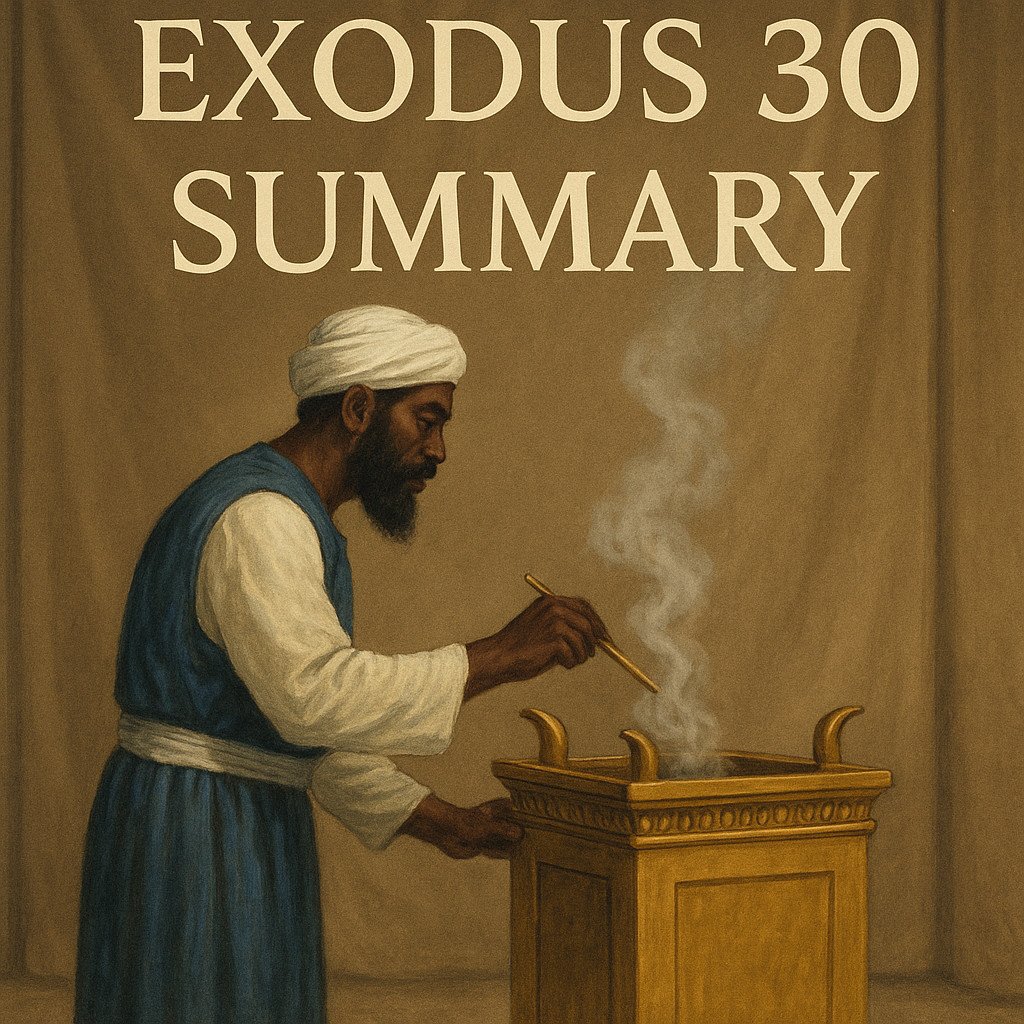
Exodus 30 Summary: Altar of Incense, Atonement Money, Laver (Wash Basin), Holy Oil
Exodus 30 provides four major priestly instructions that shaped Israel’s temple practices (which are lost forever): the altar of incense, the collection of atonement money, the laver (wash basin) for priestly cleansing, and the holy anointing oil and incense mixture reserved only for the sanctuary. This Exodus 30 summary highlights how these elements preserved holiness and protected Israel’s access to the presence of God.
For the full series on these chapters, visit the Holy Instructions for the Tabernacle and Priesthood for Israel (Exodus 25–31) hub page.
Read the chapter here: Exodus 30 KJV.
The Altar of Incense
God commands Moses to build a small altar overlaid with pure gold, placed directly in front of the veil where the ark of the testimony stood. This altar of incense was not for animal sacrifices but for continual burning incense every morning and evening when Aaron trimmed the lamps.
The incense symbolized the prayers of Israel rising before God at all times. The altar’s horns were to be touched once a year with atonement blood during the annual Day of Atonement ceremony, showing that even the place of prayer required cleansing.
No strange incense, burnt offerings, or grain offerings were permitted on it. It was set apart solely for God’s presence.
The Atonement Money (Half Shekel Offering)
Every Israelite twenty years old and above was required to give half a shekel as atonement money when they were numbered. This offering prevented a plague from breaking out during the census.
This half-shekel ransom represented each life before God. It was equal for all—rich and poor—showing that every Israelite stood on the same ground when it came to atonement.
The money collected would be used for the service of the Tabernacle, becoming a continual reminder that the people were redeemed and belonged to God.
The Laver (Wash Basin) for Priestly Cleansing
God instructs Moses to make a laver (wash basin) of bronze and place it between the altar of burnt offering and the Tabernacle entrance. Aaron and his sons were required to wash their hands and feet before approaching the altar or entering the tent.
The purpose was clear: if they did not wash, they would die.
This cleansing ritual emphasized purity, reverence, and careful preparation when stepping into God’s presence. The laver served as a lasting ordinance for all generations of priests.
The Holy Anointing Oil
God provides Moses with a detailed recipe for the sacred anointing oil. It was made from:
- Pure myrrh
- Sweet cinnamon
- Sweet calamus
- Cassia
- Olive oil
This mixture created a holy anointing oil used to consecrate the Tabernacle, the ark, the table, the candlestick, the altars, the laver, and the priests themselves.
Nothing else in Israel could be made using this formula. Anyone who imitated the oil or used it for personal purposes would be cut off from the people. Its holiness symbolized God’s exclusive claim over His sanctuary.
The Sacred Incense Mixture
Finally, God gives Moses the formula for the holy incense. Like the anointing oil, it was unique and forbidden for personal use. It was beaten very small and placed before the testimony inside the Tabernacle.
The fragrance was for God alone. Anyone who made incense to smell like it for themselves would be cut off.
These restrictions protected the sacredness of worship and reinforced the distinction between the holy and the common.
Closing Notes: Exodus 30 Summary
This Exodus 30 summary captures the holiness required for Israel’s worship: sacred incense, required atonement money, ritual washing at the laver (wash basin), and the exclusive anointing oil that set apart every vessel and priest for service. These instructions guarded the sanctity of God’s presence and established a careful pattern of holiness for Israel’s worship.