Introduction – Summary of the Bible Story of Shem
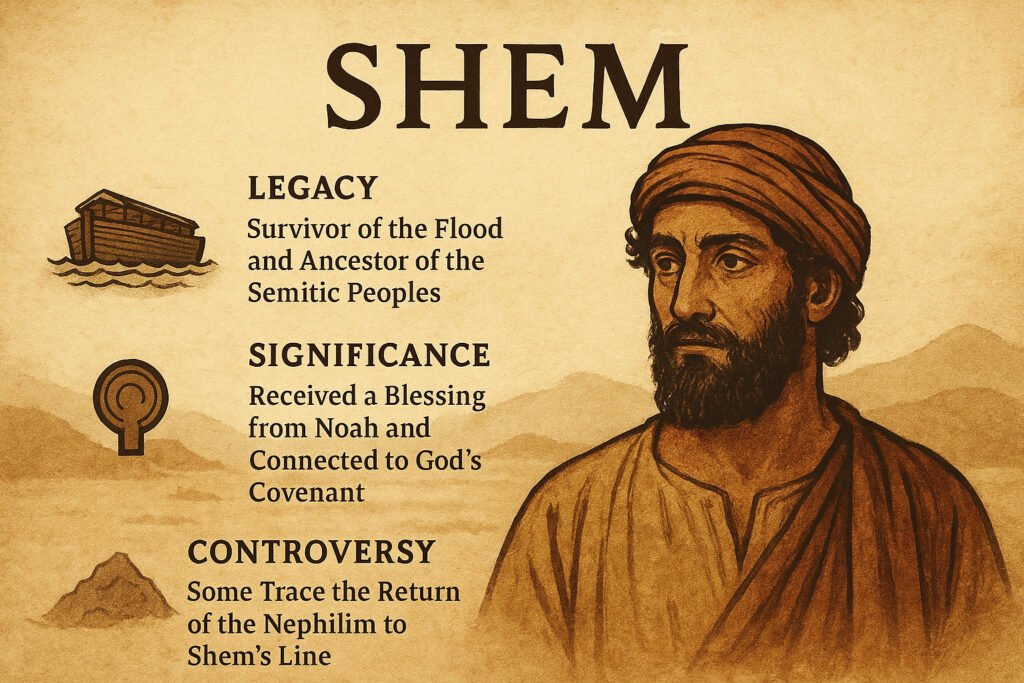
This Summary of the Bible Story of Shem presents a clear and focused account of Shem’s life, legacy, and theological place in Scripture. Alongside Ham and Japheth, Shem survived the Great Flood, helped repopulate the earth, and became the ancestor of the Semitic peoples—including the Hebrews and Israelites. His name, meaning “name” or “renown”, reflects his lasting honor in the biblical record.
Some traditions also suggest that parts of Shem’s lineage later intermingled with Canaanite groups after the Flood, contributing to theories about a second rise of the Nephilim. Read this article for a full understanding of that perspective.
Shem Before and During the Flood – Summary of the Bible Story of Shem
Shem in the Bible first appears in Genesis 5:32, listed with Ham and Japheth. Although Scripture does not call him the oldest, he is often listed first, indicating a position of prominence. When God warned Noah of the coming judgment, Shem helped build the ark and entered it with his family before the waters came. These eight individuals became the only survivors of a world overcome by wickedness.
The Flood brought forty days of rain, followed by months of receding waters. The family remained inside the ark for roughly a year. When they emerged, God commanded them to multiply and replenish the earth, marking the beginning of post-Flood human history.
Honor and Blessing After the Flood
A pivotal moment in Shem’s story appears in Genesis 9:18–27 (KJV). After Noah became drunk inside his tent, Ham saw his father uncovered and told his brothers. Shem and Japheth responded differently—they walked backward with a garment and covered Noah without looking.
When Noah awoke, he blessed Shem, saying, “Blessed be the LORD God of Shem”. This blessing connected Shem’s lineage to the worship of the true God. Japheth also received a blessing, while Canaan, the son of Ham, received a curse. This scene set the spiritual direction of the generations that would follow.
Shem’s Line and Its Long Reach
Shem had five sons—Elam, Asshur, Arphaxad, Lud, and Aram—whose descendants formed major civilizations of the ancient Near East (Genesis 10:21–31, KJV). Through Arphaxad came Salah, then Eber, from whom the word “Hebrew” is derived. This transition narrows the storyline from the broader nations to the specific covenant family that leads to Abraham.
The biblical narrative continues through Shem’s descendants—Abraham, Isaac, Jacob, the prophets, and ultimately Jesus Christ. This genealogy forms the backbone of the theological and historical structure of Scripture (Genesis 11:10–26, KJV).
Shem’s Lifespan and Overlapping Generations
According to Genesis 11:10–11 (KJV), Shem lived 600 years, long enough to witness early post-Flood generations and, according to many biblical chronologies, overlap with Abraham, Isaac, and Jacob. This suggests that Shem may have personally preserved and passed on firsthand knowledge of the Flood, Noah, and the early covenant history.
Theological Significance – Summary of the Bible Story of Shem
Shem’s importance rests in three key areas. First, the covenant promise God would later give to Abraham flows through Shem’s line. Second, Noah’s blessing indicates that true worship would remain with Shem’s descendants. Third, some traditions associate Shem with Melchizedek, the priest-king in Genesis 14—though this idea is debated, it reflects the spiritual respect tied to his name.
The Meaning of Shem’s Name
The name Shem comes from the Hebrew word meaning “name,” “renown,” “fame,” or “honor.” In Scripture, a “name” represents identity, character, and reputation. Shem’s name reflects dignity and purpose, pointing to the honor God placed on him as the ancestor of the Semitic peoples and the lineage through which God would establish His covenant promises. His name carries the idea of bearing God’s reputation in the world and becoming the line through whom the knowledge of the Lord would be preserved after the flood.
Shem, the Canaanites, and the Nephilim Debate
Some interpretive traditions propose that certain descendants of Shem lived near or intermarried with the Canaanites, which some use to explain the later appearance of giants in passages such as Numbers 13 (KJV). This view is not required to understand Shem’s role in biblical history, but it remains a topic of theological interest. Read this article for a full explanation of that perspective.
Shem Family Tree
Shem
├── Elam
├── Ashur
├── Arpachshad
└── Salah
└── Eber
├── Peleg
└── Reu
└── Serug
└── Nahor
└── Terah
├── Abraham
└── Sarah
├── Nahor
└── Haran
└── Joktan
├── Almodad
├── Sheleph
├── Hazarmaveth
├── Jerah
├── Hadoram
├── Uzal
├── Diklah
├── Obal
├── Abimael
├── Sheba
├── Ophir
├── Havilah
└── Jobab
├── Lud
└── Aram
├── Uz
├── Hul
├── Gether
└── Mash
Conclusion – Summary of the Bible Story of Shem
This Summary of the Bible Story of Shem shows Shem as a crucial link between the world before the Flood and the covenant God established with Abraham. His story reflects survival, faithfulness, and God’s long-term plan to preserve righteousness through a chosen lineage—the blessed line of Shem.