Bible Story of Ishmael: Genesis 16, 17, 21 – The Life, Legacy, and Theological Significance of Abraham’s Firstborn
The Bible story of Ishmael is one of the most pivotal and far-reaching narratives in Genesis, shaping not only the family of Abraham but the story of nations. Ishmael, the firstborn son of Abraham through Hagar, stands at the intersection of promise, conflict, rejection, protection, and divine purpose. His life raises questions about inheritance, covenant, and God’s sovereignty over human plans.
This article blends the details of Genesis 16, 17, and 21 with the broader biblical picture, offering the clearest and strongest overview of Ishmael’s story.
1. The Birth of Ishmael – Genesis 16
The story begins with Sarah’s barrenness. After years without children, Sarah proposed a culturally common—yet spiritually disastrous—solution: Abraham would father a child through her Egyptian maidservant Hagar.
Hagar conceived, but tension flared immediately. Her new status caused her to “despise” Sarah, and Sarah mistreated her in return. Hagar fled into the wilderness, where the Angel of the LORD appeared to her in one of the earliest and clearest theophanies in Scripture.
The angel instructed her to return to Sarah, and he delivered a prophecy about her son:
- He would be named Ishmael (“God hears”).
- God had heard her cry.
- Ishmael would become a great nation.
- Ishmael would be a “wild man” — free, untamed, dwelling in conflict yet flourishing.
Hagar obeyed, and Ishmael was born when Abraham was 86 years old.
2. Covenant Clarification – Genesis 17
Thirteen years later, God clarified the covenant to Abraham:
- Abraham would indeed have a son by Sarah, not Hagar.
- Isaac, not Ishmael, would carry the covenant line.
- Yet Ishmael would not be forgotten.
God explicitly promised:
“As for Ishmael, I have heard thee… I will make him fruitful… and I will make him a great nation.”
(Genesis 17:20, KJV)
In other words:
- Isaac = covenant heir
- Ishmael = divinely blessed nation-builder
Both sons mattered, but in different ways.
3. Isaac’s Birth and Ishmael’s Mocking – Genesis 21:1–10
God fulfilled His promise: Sarah conceived in old age and gave birth to Isaac.
At Isaac’s weaning feast, Sarah saw Ishmael “mocking”—a word that can imply laughter, mocking, or rivalry. Whatever the exact meaning, Sarah perceived it as a threat to Isaac’s inheritance.
She demanded Abraham expel Hagar and Ishmael.
Abraham was “very distressed” because Ishmael was still his son. But God intervened again, telling Abraham to listen to Sarah because the covenant would pass through Isaac, yet God Himself would care for Ishmael.
This moment is crucial:
God—not Abraham—takes responsibility for Ishmael’s future.
4. The Banishment and Divine Rescue – Genesis 21:14–21
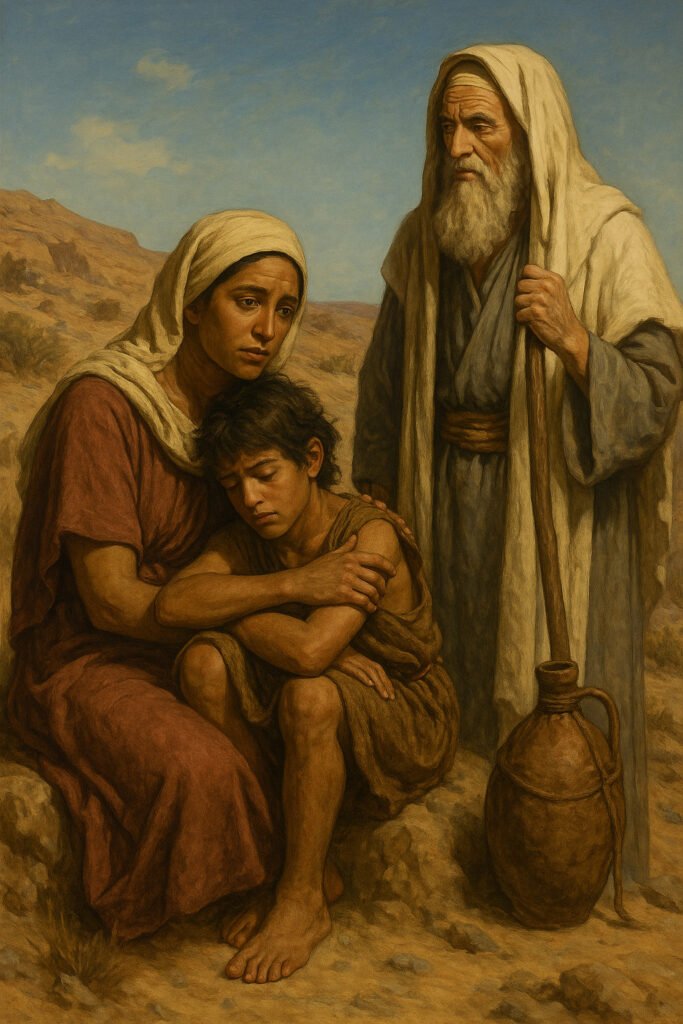
Abraham sent Hagar and Ishmael away with minimal supplies. When the water ran out in the desert, Hagar placed Ishmael under a bush and went a distance away, unable to watch him die. She wept; the boy cried.
Then God acted.
- “God heard the voice of the lad.”
- The angel of God comforted Hagar.
- God opened her eyes to a well of water.
- God reaffirmed His promise: Ishmael would become a great nation.
Ishmael survived, grew, and became an archer in the wilderness of Paran. Hagar later found him a wife from Egypt—strengthening Ishmael’s ties to his mother’s heritage.
5. Ishmael’s Legacy in Scripture
Ishmael is more than a side story. His legacy unfolds across multiple passages:
✔ Genesis 25:12–18 — The Twelve Princes
The most lasting legacy of the Bible Story of Ishmael is when he becomes the father of twelve sons, each a tribal chief. This mirrors the twelve tribes of Israel, showing divine symmetry and fulfillment of God’s promise.
✔ Genesis 28:9 — Ishmael’s Daughter
Esau marries Mahalath, Ishmael’s daughter, linking the Edomite line to Ishmael’s household.
✔ Genesis 21 & 25 — God’s Blessing
God is explicitly “with” Ishmael, even though the covenant flows through Isaac.
✔ Galatians 4:21–31 — Allegory of Flesh vs. Promise
Paul uses Sarah and Hagar symbolically—not historically—to illustrate spiritual slavery vs. spiritual freedom. The historical Ishmael remains the blessed son of Abraham; Paul’s analogy addresses covenant theology, not personal worth.
✔ Islamic Tradition (Historical Note)
While not part of the Bible, Ishmael is understood in Islamic tradition as the ancestor of many Arab peoples and a central patriarch. This mirrors, in part, the biblical statement that Ishmael would father a “great nation.”
6. Themes and Theology of the Ishmael Narrative
• God hears the suffering (Hagar & Ishmael)
God’s compassion toward the marginalized is a defining feature of this story.
• Human plans vs. divine plans
Sarah and Abraham’s attempt to “help” God created conflict—but God redeemed the situation.
• Two sons, two destinies
Isaac carries the covenant; Ishmael carries God’s blessing outside the covenant.
• Divine faithfulness to both lines
The Bible affirms the dignity and purpose of both sons.
Conclusion – The Bible Story of Ishmael
The Bible story of Ishmael is not a tale of rejection but of parallel purpose. God chose Isaac for the covenant, but He chose Ishmael for greatness, protection, and nationhood. Ishmael’s story reveals a God who sees, hears, and cares even when human relationships fracture.
Ishmael becomes one of the most influential figures in biblical and world history:
- firstborn of Abraham,
- father of twelve princes,
- ancestor of nations,
- blessed by God,
- preserved by God in the wilderness,
- and woven into the story of redemption even outside the covenant line.