Introduction: Manasseh in the Bible and the God Who Heals Memory
The Sermon on the Mount teaches believers to live with humility, mercy, and trust in God rather than pride, bitterness, or worldly status. That makes the story of Manasseh in the Bible especially meaningful. Manasseh was the firstborn son of Joseph, a man whose own life had been marked by betrayal, suffering, and divine restoration. Yet when Joseph named his son Manasseh, he chose a name tied to forgetting pain and moving forward under the hand of God.
For a broader look at how Jesus reveals the heart of God’s kingdom, you can internally link this article to your Sermon on the Mount content here.
You can also follow the main passage in Genesis 41 and Genesis 48 (KJV) with one external Scripture link here.
Manasseh in the Bible is often remembered because Jacob gave the greater visible blessing to Ephraim, the younger brother. But Manasseh’s story should not be reduced to that moment alone. He was still blessed, still counted among the tribes of Israel, and still used in the unfolding plan of God. His story reminds us that even when someone else is placed first in one moment, God has not forgotten the one who seems to be passed over.
Who Was Manasseh in the Bible?
Manasseh was the firstborn son of Joseph and Asenath, born in Egypt before the years of famine fully unfolded. He was the older brother of Ephraim. Because Joseph had been exalted in Egypt after years of suffering, Manasseh was born into a household of unusual prominence, yet his name was rooted not in pride, but in remembrance of what God had done in Joseph’s life.
Joseph named him Manasseh because “God, said he, hath made me forget all my toil, and all my father’s house” (Genesis 41:51, KJV). That does not mean Joseph literally erased his family from memory. Rather, it points to healing. God had brought Joseph through deep wounds and had begun to remove the crushing power those wounds once held over him.
So from the very start, Manasseh in the Bible stands for something important: not denial of pain, but the grace of God that helps a person move beyond it.
What Does the Name Manasseh Mean?
The name Manasseh is commonly connected to the idea of causing to forget. In Joseph’s case, the name marks a turning point. Joseph had suffered rejection from his brothers, slavery in a foreign land, false accusation, imprisonment, and years of uncertainty. But God raised him up.
That means Manasseh’s name is really part of Joseph’s testimony. Before Ephraim represented fruitfulness, Manasseh represented release from the crushing weight of sorrow. There is an order there that is worth noticing. Often God first deals with the wound, and then brings the increase. First forgetting the misery in its power over you, then fruitfulness in the land of affliction.
That makes Manasseh’s name spiritually rich. It speaks to healing, restoration, and the kind of divine mercy that keeps the past from ruling the future.
Why Is Manasseh Often Overshadowed by Ephraim?
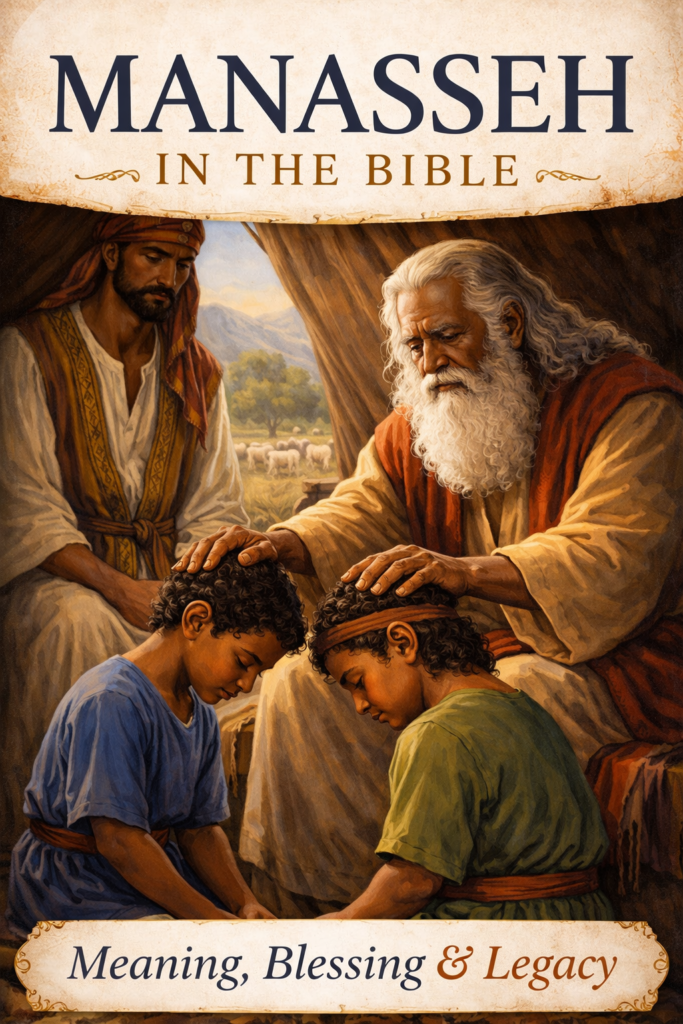
The main reason Manasseh is often overshadowed is Genesis 48. When Joseph brought his sons to Jacob for a blessing, he arranged them so that Manasseh, the older son, would receive the right-hand blessing. But Jacob deliberately crossed his hands and placed his right hand on Ephraim instead.
Joseph objected, but Jacob refused to change it. He knew what he was doing. Ephraim would become greater in prominence.
That moment is important, but it should not cause readers to think Manasseh was rejected. He was not rejected. He was blessed. Jacob’s act showed God’s sovereign freedom in choosing how certain covenant lines would be emphasized, but it did not erase Manasseh’s place in Israel.
This is one of the clearest lessons in the story of Manasseh in the Bible: a person can receive a real blessing from God even if someone else receives greater prominence. Human beings tend to think only in terms of first place and second place. Scripture often teaches differently. God’s purposes are larger than human comparison.
Did Manasseh Still Receive a Blessing?
Yes, absolutely. Genesis 48 does not present Manasseh as cursed or cast aside. Jacob specifically says that Manasseh also “shall become a people, and he also shall be great.” That matters. The issue was not whether Manasseh would be blessed, but how the two brothers would differ in future prominence.
This is where the story becomes very practical. Many people can accept that God blesses them until they see God blessing someone else more visibly. Then envy appears. But Manasseh’s story reminds us that God’s blessing is not a competition.
The Sermon on the Mount repeatedly pushes against that kind of worldly spirit. Jesus calls people away from outward status and toward righteousness of heart. Manasseh’s place in Genesis fits that lesson well. He did not receive the more dramatic prophetic prominence, but he still stood under covenant blessing.
The Tribe of Manasseh in Israel
The tribe of Manasseh became one of the tribes of Israel and eventually occupied a large inheritance. In fact, Manasseh’s descendants were substantial enough that the tribe came to hold territory on both sides of the Jordan River. That alone shows that Manasseh was not a minor footnote in biblical history.
His line endured, expanded, and mattered in the national life of Israel.
This is one reason a stand-alone article on Manasseh in the Bible is worthwhile. Readers often remember the crossed hands of Jacob but miss the long-term significance of Manasseh’s tribe. Scripture does not treat him as an afterthought. His descendants became part of the covenant people, part of the inheritance structure, and part of Israel’s historical account.
What Can We Learn from Manasseh in the Bible?
One lesson is that God can heal deep wounds. Joseph’s naming of Manasseh shows that God can bring a person to a place where pain no longer has final control. As the Sermon on the Mount says, please forgive us of our debts as we forgive others their debts. Forgiveness is necessary before we proceed to greater things
A second lesson is that being less prominent does not mean being less blessed. Manasseh did not receive the higher place that Ephraim received in that particular prophetic moment, but he still received greatness and inheritance.
A third lesson is that identity should not be built on comparison. If Manasseh’s story were told through fleshly eyes alone, it would look like a story of being passed over. But through biblical eyes, it is a story of real blessing, real legacy, and real inclusion in God’s purposes.
A fourth lesson is that God’s order is wiser than ours. Human beings naturally think the elder must always lead and the more visible blessing must always mean greater worth. Scripture keeps overturning that kind of thinking. God chooses according to divine wisdom, not human expectation.
Final Thoughts on Manasseh in the Bible
Manasseh in the Bible is much more than the older brother of Ephraim. He is the son whose name marked Joseph’s healing, the firstborn who still received blessing even when another was placed before him, and the forefather of a major tribe in Israel.
His story teaches that God’s grace can loosen the grip of old pain. It teaches that visible rank is not the same as true worth. And it teaches that God may write a person into the covenant story in ways that are quieter than someone else’s story, but no less real.
That makes Manasseh an important figure for readers today. Many know what it feels like to be overlooked, compared, or placed second in the eyes of others. But the story of Manasseh reminds us that God’s blessing is not exhausted by human rankings. God still sees. God still heals. God still gives inheritance.