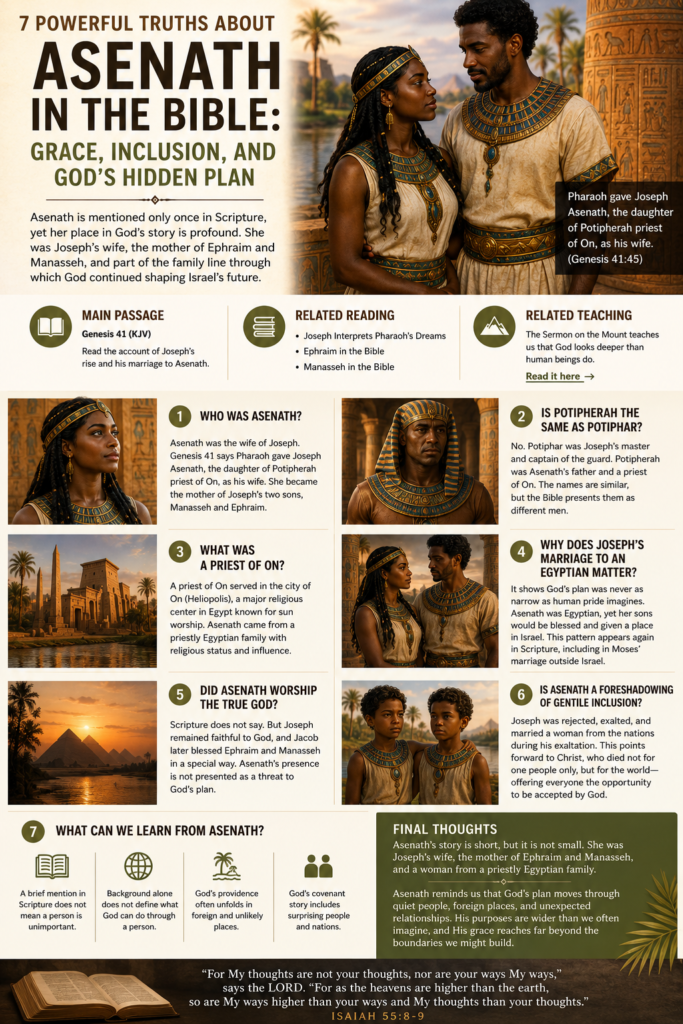
Asenath in the Bible: A Brief Figure with a Meaningful Place in Genesis
The Sermon on the Mount teaches that God looks deeper than people do. Human beings focus on background, status, and appearances, but God often works through people others might overlook. That makes the story of Asenath in the Bible worth closer attention. She is mentioned only briefly in Genesis, yet she became Joseph’s wife, the mother of Ephraim and Manasseh, and part of the family line through which God continued shaping Israel’s future.
For more on the heart of Christ’s kingdom, see The Sermon on the Mount:
https://jesus-from-the-mount.com/the-sermon-on-the-mount-niv/
For the main passage, read Genesis 41 KJV:
https://www.biblegateway.com/passage/?search=Genesis+41&version=KJV
Related reading includes Joseph Interprets Pharaoh’s Dreams, Ephraim in the Bible, and Manasseh in the Bible.
The story of Asenath in the Bible raises natural questions. Who was she? What did her Egyptian background mean? Was Joseph wrong to marry her? And why would Scripture place a woman like Asenath so close to the future tribes of Israel?
Who Was Asenath in the Bible?
Asenath was the wife of Joseph. Genesis 41 says Pharaoh gave Joseph Asenath, the daughter of Potipherah priest of On, as his wife. That short statement matters because it shows how completely Joseph’s life had changed. He had gone from prison to power, and part of that new position included marriage into an influential Egyptian family.
Asenath later became the mother of Joseph’s two sons, Manasseh and Ephraim. That means she was not a passing detail. She stood at the beginning of a line that would later matter greatly in Israel’s history.
Is Potipherah the Same as Potiphar?
No, the Bible presents them as different men.
That point needs to be clear because the names are very similar. Potiphar was the Egyptian officer of Pharaoh, captain of the guard, in whose house Joseph served as a slave. Potipherah was Asenath’s father, and Genesis identifies him as priest of On. The similar names can make readers wonder whether they are the same person, but the text treats them separately.
That distinction matters in the story of Asenath in the Bible. She was not being described as the daughter of Joseph’s former master. She was being described as the daughter of a different Egyptian official connected to religion rather than military or court security.
What Was a Priest of On?
A priest of On was a priest connected to the city of On, an important Egyptian religious center. On is commonly identified with Heliopolis, a city strongly associated with sun worship in ancient Egypt. So when Genesis says Asenath was the daughter of Potipherah priest of On, it means she came from a household with religious status in Egyptian society.
That is why her background stands out. Asenath was not only Egyptian. She came from a family tied to one of Egypt’s religious centers. The story of Asenath in the Bible therefore places Joseph, a servant of the true God, in marriage to a woman from a prominent Egyptian religious household.
Why Does Joseph’s Marriage to an Egyptian Matter?
Joseph’s marriage to Asenath is significant because it shows that God’s covenant story was never as narrow as many people assume. Asenath was Egyptian, and not only Egyptian, but from a priestly Egyptian household. Yet she became the wife of Joseph and the mother of Ephraim and Manasseh, two sons who were later given an important place in Israel’s tribal story.
That does not erase the unique covenant role of Israel, but it does show that God’s redemptive plan was already reaching across national lines very early in Scripture. The family history leading toward Christ was not made up of only one kind of background. Even in Genesis, God was already showing that His purposes were wider than human pride, tribalism, or bloodline boasting.
The same broad pattern appears elsewhere in Scripture. Moses also married outside Israel, and the Bible repeatedly shows that God’s purposes reach beyond a single nation. The story of Asenath in the Bible fits that larger witness and reminds readers that God’s chosen line was never meant to feed racial pride or narrow human boasting.
Did Asenath Worship the True God?
Scripture does not directly say whether Asenath came to worship the God of Joseph. That silence matters, and it is wise not to claim more than the text says.
What can be said is this: Joseph remained faithful to God in Egypt, his sons were not treated as outside the covenant story because of their mother’s background, and Jacob later blessed Ephraim and Manasseh in a special way. That means Asenath’s presence in Joseph’s life is not treated as a threat to God’s plan.
Whether she personally turned to the true God is left unstated. The story leaves readers with a real silence there.
Why Is Asenath Important?
Asenath matters because through her came Ephraim and Manasseh. That alone gives her a meaningful place in Genesis. She also helps mark Joseph’s transition from suffering servant to exalted ruler. When Joseph received a new name, a new office, and a wife in Egypt, the narrative was showing how dramatically God had changed his condition.
The story of Asenath in the Bible also fits one of Genesis’s recurring patterns: God works through surprising people and unlikely settings. The covenant family does not develop in a neat, isolated line untouched by outsiders. Again and again, Genesis shows God moving through messy history, foreign places, and unexpected relationships.
Is Asenath a Foreshadowing of Gentile Inclusion?
It is wise to speak carefully here, but Asenath’s place in the story does invite reflection. Joseph was rejected by his brothers, humbled through suffering, and then exalted among the nations. During the time of his exaltation, he was joined to a woman from the nations. Later, his brothers were brought back into relationship with him.
That pattern should not be pushed beyond what Scripture says, but it is reasonable to notice how suggestive it is. Joseph’s life already invites broad foreshadowing reflection, and Asenath’s place in that story adds to it. In that sense, the story of Asenath in the Bible can be read as a quiet hint that God’s saving purpose would one day open outward in a fuller way.
Joseph, as a rejected and exalted deliverer, can point readers forward to Christ. And Joseph’s marriage to an Egyptian woman can suggest, in a broad foreshadowing way, that Christ’s saving work would not be limited to one people only. Jesus died for the world, and the opportunity to be accepted by God is held out far beyond one bloodline or nation.
What Can We Learn from Asenath in the Bible?
One lesson is that a brief mention in Scripture does not make a person unimportant. Asenath appears only a little, but her role is significant.
Another lesson is that background alone does not tell the whole story. The story of Asenath in the Bible reminds readers not to assume that someone’s place of origin or family setting fully defines what God may do through that person.
A third lesson is that God’s providence often unfolds in foreign and unlikely places. Joseph did not plan to build a life in Egypt, yet God was clearly at work there.
A fourth lesson is that covenant history includes surprising people. Asenath stands near major developments in Israel’s future, even though Scripture introduces her briefly.
Final Thoughts on Asenath in the Bible
The story of Asenath in the Bible is short, but it is not small. She was Joseph’s wife, the mother of Ephraim and Manasseh, and a woman whose Egyptian priestly background makes her place in Genesis especially striking.
Asenath reminds readers that God’s plan often moves through quiet people, foreign places, and unexpected relationships. She also reminds readers that God is able to bring covenant blessing through circumstances no one would have arranged on their own.
Seen that way, Asenath becomes more than a passing note in Joseph’s rise. She becomes another witness to the quiet wisdom of God and another early sign that God’s redemptive purposes were wider than human pride often imagines.