 Skip to content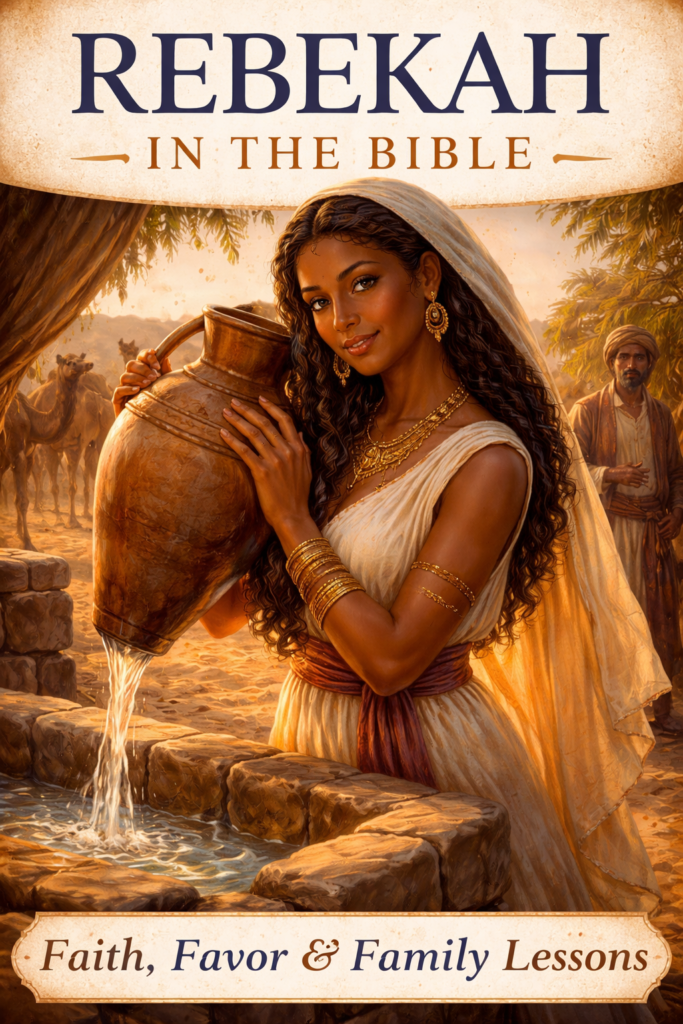
Rebekah in the Bible: A Woman Chosen at a Turning Point
The Sermon on the Mount teaches that the people of God are called to pursue righteousness, trust God’s wisdom, and avoid the kind of division that grows when human beings try to force outcomes in the flesh. That makes Rebekah in the Bible a deeply important study. Rebekah was not a minor figure in Genesis. She stood at a turning point in the covenant line, became the wife of Isaac, gave birth to Jacob and Esau, and helped shape one of the most important family stories in all of Scripture.
For more on the heart of Christ’s kingdom, see [The Sermon on the Mount].
You can also read the main account in [Genesis 24 (KJV)], along with the later family conflict in Genesis 25 and Genesis 27.
Rebekah in the Bible is a story of beauty, hospitality, decisiveness, and faith. But it is also a story marked by family tension and painful consequences. She is one of the clearest examples in Genesis of a woman who played a major role in God’s unfolding plan, yet whose choices still brought sorrow into her household.
Who Was Rebekah in the Bible?
Rebekah was the wife of Isaac and the mother of Jacob and Esau. She first appears when Abraham, not wanting Isaac to marry among the Canaanites, sent his servant back toward his own people to find a wife for the promised son. Rebekah became the answer to that mission.
Her introduction is memorable because it immediately shows strength of character. Abraham’s servant prayed for a specific sign. He asked that the chosen young woman would not only offer him water, but would also voluntarily draw water for his camels. Rebekah did exactly that.
This matters because watering camels was not a light task. It showed energy, generosity, and willingness to serve. So when we first meet Rebekah in the Bible, she appears as a woman of action. She is not passive. She is attentive, hospitable, and ready to move when the moment comes.
How Did Rebekah Become Isaac’s Wife?
After Rebekah fulfilled the sign Abraham’s servant had prayed for, the servant learned that she was from Abraham’s extended family. That confirmed that God had guided the journey. Rebekah’s family eventually agreed to the marriage, and when asked whether she would go, Rebekah answered decisively, “I will go.”
That short answer says a great deal about her.
Rebekah was willing to leave her home, her familiar surroundings, and her family in order to step into the covenant household. In that sense, she reflects a kind of faith that is easy to miss. She agreed to join a future she could not fully see. She would become the wife of a man she had never met and enter a life shaped by promises given long before she was born.
When Isaac finally saw her, the union was completed, and Rebekah became his wife. Genesis presents this as a divinely guided marriage, not merely a human arrangement. That makes Rebekah in the Bible especially important, because she became part of the line through which the covenant promises continued.
What Was Rebekah Like?
Rebekah appears in Genesis as beautiful, capable, discerning, and strong-willed. Those qualities made her memorable, but they also help explain the later tension in her home.
At first, her strength looks entirely admirable. She is generous to a stranger. She moves decisively. She steps into an unfamiliar future. Later, when she is barren, Isaac prayed for her, and the Lord granted conception. Even during her difficult pregnancy, Rebekah sought the Lord when she sensed an unusual struggle in her womb.
That is another major detail. Rebekah did not simply wonder about what was happening. She went to inquire of the Lord. She wanted divine understanding.
The answer she received was prophetic: two nations were in her womb, two manner of people would be separated from within her, and the elder would serve the younger. That word shaped everything that followed.
Why Did Rebekah Favor Jacob Over Esau?
One of the most discussed parts of Rebekah in the Bible is her favoritism. Genesis says Isaac loved Esau, but Rebekah loved Jacob. That family split became the seedbed for later deception and division.
Part of Rebekah’s preference for Jacob may have been tied to the prophecy she received. She knew that God had said the elder would serve the younger. She may have believed that Jacob was the chosen son in the covenant line. In that sense, her instinct was pointed in the right direction.
But the way she handled matters created trouble.
Instead of waiting on God to bring the prophecy to pass in God’s own way, Rebekah helped Jacob deceive Isaac in order to obtain the blessing. That moment changed the family forever. Jacob received the blessing, but Esau burned with anger, and Jacob had to flee.
This is one of the great lessons from Rebekah’s life. A person can correctly understand something about God’s purpose and still act wrongly in trying to accomplish it. Rebekah seems to have believed the right son should receive the blessing, but she relied on manipulation rather than trust.
What Does Rebekah in the Bible Teach Us About Family Conflict?
Rebekah’s household became divided by preference, secrecy, and strategy. Isaac leaned one way, Rebekah another, and the sons themselves grew in opposite directions. By the time Genesis 27 unfolds, the home is already fractured.
That is why Rebekah in the Bible is not only a story of calling, but also a warning. Family division often grows long before the visible breaking point. Favoritism, private agendas, and spiritual impatience can slowly damage a household.
And yet Rebekah’s story is not presented to shame her alone. It is presented as part of the realism of Genesis. God’s covenant moved through flawed people. The Lord did not abandon the promise simply because the family acted badly. That should both humble and encourage us. Human failure is real, but God’s purpose still stands.
If you want the larger fallout from Rebekah’s decision, see [the Bible story of Jacob and Esau].
What Can We Learn from Rebekah in the Bible?
One lesson is that faith sometimes looks like leaving the familiar behind. Rebekah left home and entered an unknown future because God was guiding the way.
A second lesson is that spiritual sensitivity matters. Rebekah inquired of the Lord when she did not understand what was happening inside her womb. That is a strong example. She sought divine insight rather than settling for confusion.
A third lesson is that discernment must be joined with patience. Rebekah seems to have understood something important about Jacob’s role, but she still chose a fleshly method to push events forward. That is a danger for every believer. We may perceive a truth and still mishandle the timing.
A fourth lesson is that family favoritism can be destructive. Love that becomes partiality can damage relationships for generations. Rebekah’s story warns against shaping a home through preference instead of righteousness.
Final Thoughts on Rebekah in the Bible
Rebekah in the Bible is one of the most significant women in Genesis. She was chosen for Isaac through divine guidance, stepped into covenant history with courage, sought the Lord in a moment of mystery, and became the mother of Jacob and Esau. Her life contains both admirable faith and painful missteps.
That makes her story powerful.
She reminds us that God often works through strong and imperfect people. She also reminds us that knowing part of God’s will is not the same as trusting God’s timing. Rebekah believed something important about Jacob’s future, but the path she chose helped tear her household apart.
Even so, her life still stands inside the covenant story. God used her, and Scripture does not hide either her value or her weakness. That honesty is one reason her story continues to matter. Rebekah in the Bible shows both the beauty of stepping forward in faith and the danger of trying to force what God has promised.
For more background on the covenant family line, see [Chapter by Chapter Summary of Genesis].