 Skip to content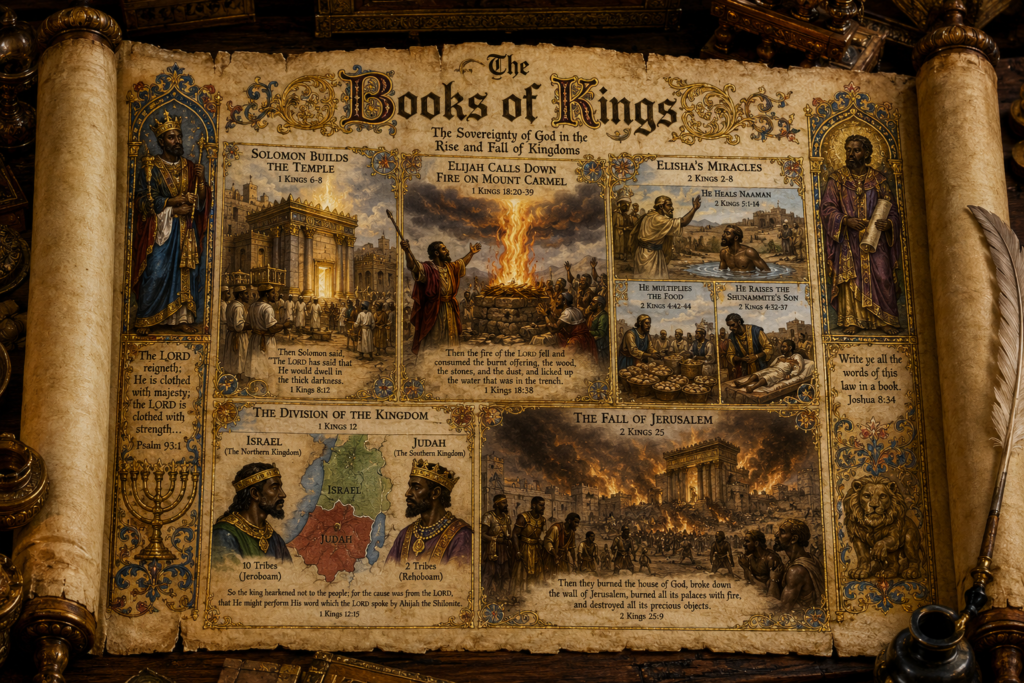
Overview of the Books of Kings
The Books of Kings trace the history of Israel and Judah from the final days of King David through the Babylonian exile. Originally one book in the Hebrew Bible, 1 Kings and 2 Kings explain not only what happened to God’s people, but why it happened. The books evaluate each king according to his faithfulness to God and demonstrate how obedience brings blessing while idolatry and rebellion bring judgment.
The Books of Kings provide a powerful illustration of Jesus’ Sermon on the Mount teaching that believers are to be “the light of the world” and “the salt of the earth.” Israel was called to be a nation that reflected God’s character to the surrounding world, but many of its kings abandoned that calling through idolatry, injustice, and compromise. Instead of shining God’s light, they often blended into the darkness of the nations around them. Instead of preserving truth and righteousness, they lost their spiritual distinctiveness.
As Jesus warned, light hidden under a basket serves no purpose, and salt that loses its saltiness becomes ineffective. The rise and fall of Israel and Judah demonstrate the consequences of a people who were meant to display God’s glory but repeatedly concealed that witness. Yet the faithful prophets, righteous kings, and remnant believers show that even in times of widespread unfaithfulness, God’s people are called to shine brightly and remain spiritually distinct, pointing others back to Him.
Solomon and the United Kingdom
The narrative in the Books of Kings begins with Solomon succeeding David as king. Solomon is celebrated for his wisdom, wealth, and the construction of the First Temple in Jerusalem. Under his rule, Israel experiences peace and prosperity. However, Solomon later turns to foreign gods and imposes heavy burdens on the people, setting the stage for national division.
The Division of Israel
After Solomon’s death, the kingdom splits into two nations:
- Israel (Northern Kingdom) under Jeroboam
- Judah (Southern Kingdom) under Rehoboam
Israel quickly falls into idolatry and never returns to faithful worship. Judah experiences periods of both faithfulness and rebellion depending on its rulers. The books repeatedly show that the spiritual condition of the king influences the spiritual condition of the nation.
The Prophets Elijah and Elisha
God raises up prophets to call the people back to covenant faithfulness. Elijah boldly confronts King Ahab and Queen Jezebel, challenges the worship of Baal, and demonstrates God’s power through miraculous events. One of the most famous moments in Kings is Elijah’s victory over the prophets of Baal on Mount Carmel.
After Elijah’s ministry, Elisha continues the prophetic work. Through miracles, healings, and acts of compassion, Elisha reveals God’s concern for both rulers and ordinary people while continuing to warn the nation about its unfaithfulness.
The Importance of the Temple
The Temple stands at the center of Israel’s worship and identity. Built by Solomon as a dwelling place for God’s name, it becomes a symbol of God’s presence among His people. The dedication of the Temple marks one of the high points of Israel’s history.
Yet the Temple’s eventual destruction serves as a powerful reminder that religious institutions cannot protect a nation that continually rejects God’s covenant. The rise and fall of the Temple mirrors the spiritual condition of the kingdom itself.
The Fall of Israel and Judah
Because of persistent idolatry, injustice, and covenant violation, the Northern Kingdom of Israel is conquered by Assyria in 722 BC. Its people are scattered and exiled, bringing an end to the kingdom.
Judah survives longer and experiences significant reforms under faithful kings such as Hezekiah and Josiah. Despite these efforts, the nation ultimately returns to disobedience. In 586 BC, Babylon conquers Jerusalem, destroys the Temple, and carries many of the people into exile.
The author presents these events not merely as political disasters but as the fulfillment of warnings delivered through generations of prophets.
The Davidic Covenant and Hope
A central question throughout Kings is whether God’s promise to David will survive the failures of David’s descendants. Although many kings fall into sin and the kingdom itself collapses, God’s covenant remains a thread of hope running through the narrative.
The books conclude with the release of the exiled King Jehoiachin from prison in Babylon. This seemingly small event suggests that the line of David has not been extinguished and that God’s promises remain alive despite judgment and exile.
Major Themes of the Books of Kings
Faithfulness to God
Kings who honor God generally bring blessing and stability, while those who embrace idolatry lead their nations toward destruction.
The Role of Leadership
The moral and spiritual character of leaders has profound consequences for the people they govern.
Prophetic Guidance
God continually sends prophets to warn, correct, and encourage His people, demonstrating His desire for repentance rather than destruction.
Divine Justice and Mercy
The exile reveals God’s justice against persistent rebellion, yet His continued faithfulness to His promises demonstrates His mercy.
Covenant Faithfulness
The books emphasize God’s covenant with David and show that even national failure cannot completely nullify God’s purposes.
Hope for Restoration
Though Kings ends in exile, it leaves readers with the expectation that God is not finished with His people and that restoration remains possible.
Conclusion
The Books of Kings are more than a record of political history. They explain Israel’s rise and fall through the lens of its relationship with God. From Solomon’s wisdom and the glory of the Temple to the division of the kingdom, the ministries of Elijah and Elisha, and the eventual exile, the narrative consistently demonstrates the consequences of faithfulness and unfaithfulness.
Yet the final message is not one of despair. Even in exile, God’s covenant promises endure. The survival of David’s line points forward to future restoration and reminds readers that judgment is never the final word in God’s redemptive plan.
