Melchizedek in the Bible: A Mysterious Priest-King Who Points Beyond Himself
The Sermon on the Mount calls readers to hunger after righteousness and to seek the kind of peace that comes from God rather than from the world. That makes the story of Melchizedek in the Bible especially powerful. Melchizedek appears only briefly in Genesis, yet the Bible returns to him in Psalm 110 and Hebrews 5 through 7. Those later passages show that this is no minor figure. Melchizedek becomes one of Scripture’s clearest pictures of a priesthood greater than the Levitical order and a kingship joined with righteousness and peace.
For more on the heart of Christ’s kingdom, see The Sermon on the Mount. For the main passages, read Genesis 14 KJV, Psalm 110 KJV, and Hebrews 7 KJV.
Who Was Melchizedek in the Bible?
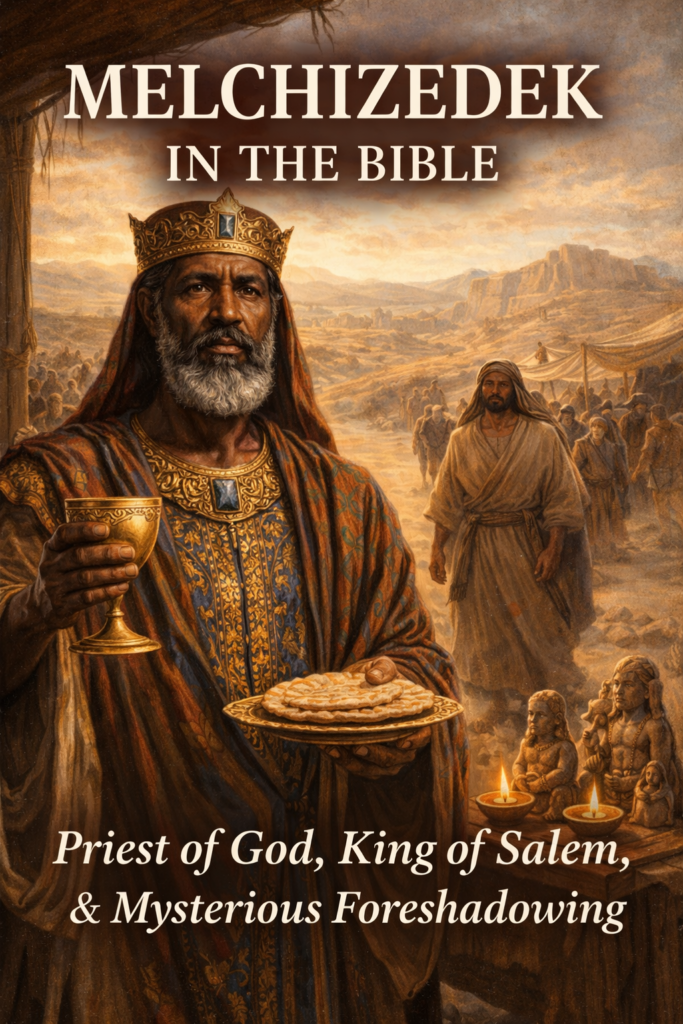
Melchizedek first appears in Genesis 14 after Abram rescues Lot and defeats a coalition of kings. As Abram returns from battle, Melchizedek meets him, brings out bread and wine, blesses him, and is identified as both the king of Salem and the priest of the most high God. Abram then gives him tithes of all. That brief scene is the whole narrative foundation, yet it is loaded with significance.
The name Melchizedek is commonly understood to mean “king of righteousness.” Salem is usually connected with peace, so Melchizedek is presented as a king of righteousness and a king of peace. Even before the New Testament comments on him, the story of Melchizedek in the Bible already carries symbolic force.
Why Did Abraham Give Melchizedek Tithes?
Abram’s response is one of the most striking parts of the account. He receives Melchizedek’s blessing and gives him a tenth of the spoil. That action suggests recognition of Melchizedek’s spiritual greatness. Abram is the covenant patriarch, yet he receives blessing from this priest-king and honors him with tithes. Hebrews later uses that very point to argue that Melchizedek’s priesthood stands above the priesthood that would later come through Levi.
That is one reason the story of Melchizedek in the Bible matters so much. The passage is not merely showing a courteous exchange after battle. It is showing Abram acknowledging someone whose priestly standing is extraordinary.
Was Melchizedek a Man, an Angel, or Christ Himself?
This is one of the main questions readers ask. The safest answer is that Melchizedek is presented as a real historical person who also functions as a profound type of Christ. Genesis treats him like a real king and priest. Hebrews does not say Jesus was Melchizedek; it says Christ is “made like unto the Son of God” in the way Melchizedek is presented in Scripture and that Christ is a priest for ever after the order of Melchizedek.
Some readers have wondered whether Melchizedek was a pre-incarnate appearance of Christ. That view exists because Hebrews describes him in such exalted terms. Still, the stronger and more careful reading is that Melchizedek was a real man whose biblical presentation was designed to foreshadow Christ in an unusual way. That keeps the language as high as Hebrews gives it without going beyond what the text clearly says.
Why Does Hebrews Spend So Much Time on Melchizedek?
Hebrews returns to Melchizedek because he helps explain why Jesus can be the final High Priest without belonging to the tribe of Levi. Under the law, priests came from Levi. Jesus came from Judah. So Hebrews points to an older and greater priestly pattern, one that existed before Levi and does not depend on genealogical descent in the same way. Melchizedek becomes the key example.
This matters because the account of Melchizedek in the Bible opens a window into the superiority of Christ. Jesus is not a temporary priest serving under an earthly system that must be repeated. He is the everlasting priest. Melchizedek helps readers see that God’s priestly plan was always larger than the Levitical order alone.
What Does Melchizedek Teach About Righteousness and Peace?
Melchizedek’s name and title fit the order of God’s kingdom beautifully. Righteousness comes first, then peace. That pattern fits the Sermon on the Mount, where Jesus teaches that true peace is not produced by compromise with sin, but by alignment with God’s righteousness. Peace in Scripture is deepest and safest when it rests on what is right.
That is part of why Melchizedek continues to fascinate readers. Even his brief appearance points beyond military success and earthly politics. Abram has just won a battle, yet the scene turns immediately toward blessing, priesthood, righteousness, and peace. The focus shifts from human strength to divine order.
What Can Readers Learn from Melchizedek in the Bible?
One lesson is that God can place important witnesses in history even when Scripture gives only a small amount of narrative detail about them. Another is that greatness before God is not always tied to how much page space a person receives. Melchizedek appears briefly, but his significance reaches across the canon.
A second lesson is that Christ fulfills what earlier figures could only foreshadow. Melchizedek was not the final priest-king. He pointed to the One who would be. A third lesson is that righteousness and peace belong together. The kingdom of God is not built on appearance alone. It rests on what is just, holy, and true.
Final Thoughts on Melchizedek in the Bible
Melchizedek in the Bible is one of Scripture’s most intriguing figures because he stands at the meeting point of mystery and revelation. He appears suddenly, blesses Abram, receives tithes, and then seems to disappear. Yet Psalm 110 and Hebrews show that he did not disappear from God’s larger purpose. His brief appearance was meant to point readers forward.
Seen that way, Melchizedek is not important because he is obscure. He is important because he helps reveal Jesus Christ as the true priest-king, the One whose righteousness is perfect and whose peace is everlasting. That is why Melchizedek deserves a stand-alone article. The story of Melchizedek in the Bible is short, but its reach is tremendous.