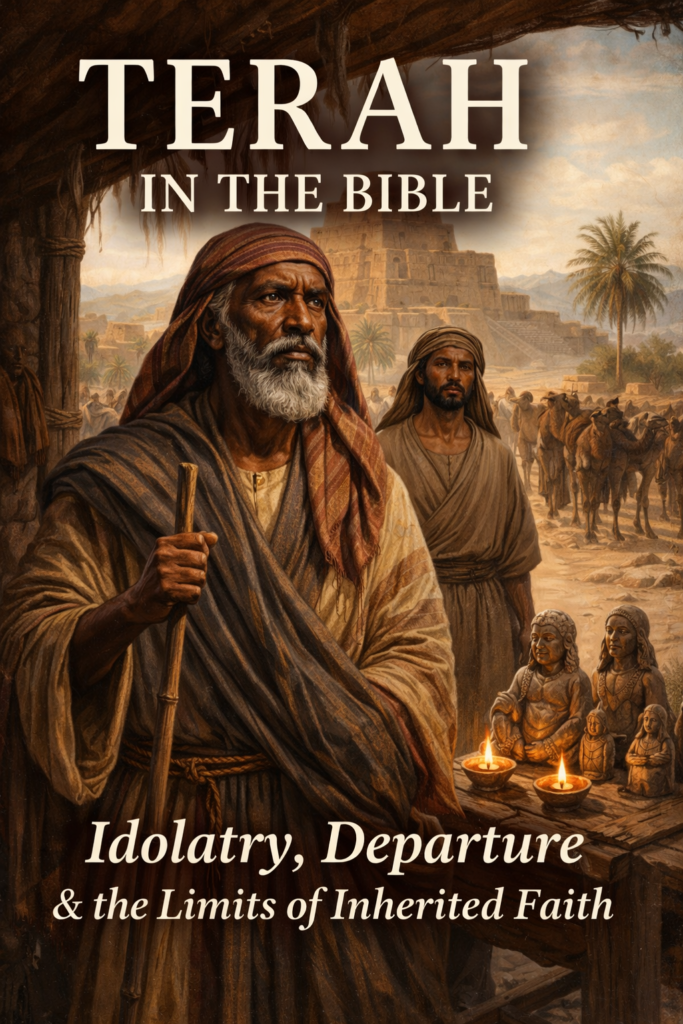
Terah in the Bible: Why His Story Matters
The story of Terah in the Bible is brief, but it opens an important discussion about heritage, calling, and responsibility before God. Terah is remembered as the father of Abram, Nahor, and Haran. He also stands near the turning point where God began to call Abram out from an idolatrous background toward the land of promise.
The Sermon on the Mount passage that best frames the story of Terah in the Bible is Jesus’ warning against hypocritical judgment: “Judge not, that ye be not judged,” and “first cast out the beam out of thine own eye” (Matthew 7:1-5). Terah’s family line reminds readers that outward connection to sacred history does not automatically settle every question about a person’s heart. Scripture invites humility, not quick assumptions.
For more on the heart of Christ’s kingdom, see The Sermon on the Mount. For the main passages, read Genesis 11:26-32 KJV, Genesis 12:1 KJV, Joshua 24:2 KJV, and Luke 12:47-48 KJV.
Who Was Terah in the Bible?
Terah was the father of Abram, Nahor, and Haran. Genesis 11 places him in the generations after Shem and before the call of Abram. Haran died before his father in Ur of the Chaldees, and Haran’s son Lot remained closely tied to Abram afterward.
So when readers think about Terah, they should not think only of a name in a genealogy. Terah stands at the head of the household from which Abram emerged. In that sense, Terah matters because his family became the immediate human setting out of which the covenant story moved forward.
Where Was Terah From, and Where Did He Go?
Genesis says Haran died in Ur of the Chaldees, which strongly suggests that Terah and his family were living there. Later, Genesis 11:31 says Terah took Abram, Lot, and Sarai and went forth with them from Ur of the Chaldees to go into the land of Canaan; yet they came unto Haran and dwelt there.
That detail raises one of the natural questions readers ask about the life of Terah in the Bible: did God tell Terah to start toward Canaan, or did he move on his own? The text never plainly says that God called Terah. Genesis 12 records the call to Abram, not to Terah. So the safest conclusion is that Terah did in fact begin the journey toward Canaan, but Scripture does not directly tell readers that this first movement came from a divine command given to him personally.
That matters because Haran became a stopping point. Terah began a journey toward Canaan, but he did not finish it. Abram would later continue under the clear call of God.
What Does the Name Terah Mean?
The exact meaning of the name Terah in the Bible is not completely certain. Some scholars connect it with ideas such as delay, wanderer, or station, but Scripture itself does not define the name the way it does some other biblical names.
That means readers should be careful not to build too much theology on the possible meaning of Terah’s name. The stronger biblical observations come from what the text actually says about his family, his migration, his age, and the worship background of his household.
How Long Did Terah Live?
Genesis 11:32 says, “And the days of Terah were two hundred and five years: and Terah died in Haran.” That gives one of the clearest small details in the story of Terah in the Bible. He lived 205 years and died in Haran, not in Canaan.
That short verse also carries symbolic weight. Terah’s life closed in the place where the family had settled on the way, while Abram’s next chapter opened with a fresh call to keep moving. Terah’s ending and Abram’s beginning are placed side by side for a reason.
Did Terah Worship Other Gods?
Joshua 24:2 gives one of the most important statements about Terah: “Your fathers dwelt on the other side of the flood in old time, even Terah, the father of Abraham, and the father of Nachor: and they served other gods.” That verse answers a major question directly. Terah and his household had an idolatrous background.
That also helps explain why Abram’s calling was so significant. God was not merely nudging a family that already understood the truth clearly. God was calling Abram out from a household that had been shaped by false worship.
Whether Abram himself participated personally in that worship before God called him is not spelled out in detail. Joshua 24 does show the family setting around him. So the story of Terah in the Bible becomes an important reminder that a godly future can begin in an ungodly environment.
Was Terah Condemned, and How Does Judgment Work?
This is where readers should move carefully and humbly. Joshua 24 shows that Terah served other gods, but Scripture never directly tells readers Terah’s final eternal condition. That means no one should speak more confidently than the text allows.
At the same time, Scripture does teach that judgment takes account of knowledge and light. Luke 12:47-48 says the servant who knew his lord’s will and disobeyed received greater punishment, while the one who did not know received less. John 15:22 adds another important layer: “If I had not come and spoken unto them, they had not had sin: but now they have no cloke for their sin.” Romans 2:12 and James 4:17 point in the same direction. The fuller the light, the greater the accountability, and God judges with perfect justice.
Terah’s story opens the door to an important reflection. Being in the family line that leads to Christ does not automatically prove that every person in that line was saved. Physical connection to the covenant story is not the same as personal faithfulness. The wise response is neither careless universalism nor harsh certainty, but reverent humility before the God who judges perfectly.
Was Terah a Father of Many Nations Too?
In one sense, every earlier ancestor in Abraham’s line contributed biologically to the nations that would come later. Terah was certainly an ancestor of many people through Abram, Nahor, and their wider family line.
But Scripture gives Abraham a special title for a reason. Abraham was not merely a physical ancestor. He became the covenant father of many nations by divine promise. God spoke that role directly over Abraham in a unique way. So Terah was an ancestor in the line, but Abraham received the covenant designation in a way Terah did not.
What Can We Learn from Terah?
First, heritage alone is not enough. A person may stand near the covenant line and still not be the one who walks in the fullness of the call.
Second, starting a journey is not the same as finishing it. Terah set out toward Canaan but stopped in Haran. That gives the story of Terah in the Bible a quiet sadness as well as significance.
Third, God can call someone out of a confused or idolatrous background. Abram’s story begins there, which means no family history is too tangled for God to overcome.
Fourth, readers should be slow to judge with more confidence than Scripture gives. Terah’s life fits well with Christ’s warning in Matthew 7. It is easy to make sweeping pronouncements about other people while ignoring how partial our own knowledge can be.
Final Thoughts on Terah in the Bible
Terah in the Bible is not one of Genesis’s longest character studies, but he raises some of its most thoughtful questions. He lived in Ur, moved toward Canaan, stopped in Haran, fathered the household from which Abram emerged, and came from a background of serving other gods.
Because of that, Terah’s story invites more than a quick summary. It invites humility. It reminds readers that family heritage, physical descent, and proximity to sacred history are not simple substitutes for true faith. It also reminds readers that God’s call can break into a household with a troubled spiritual past and begin something new.
Seen that way, Terah is not merely a name before Abraham. He is part of the setting that makes Abraham’s call shine all the more clearly.