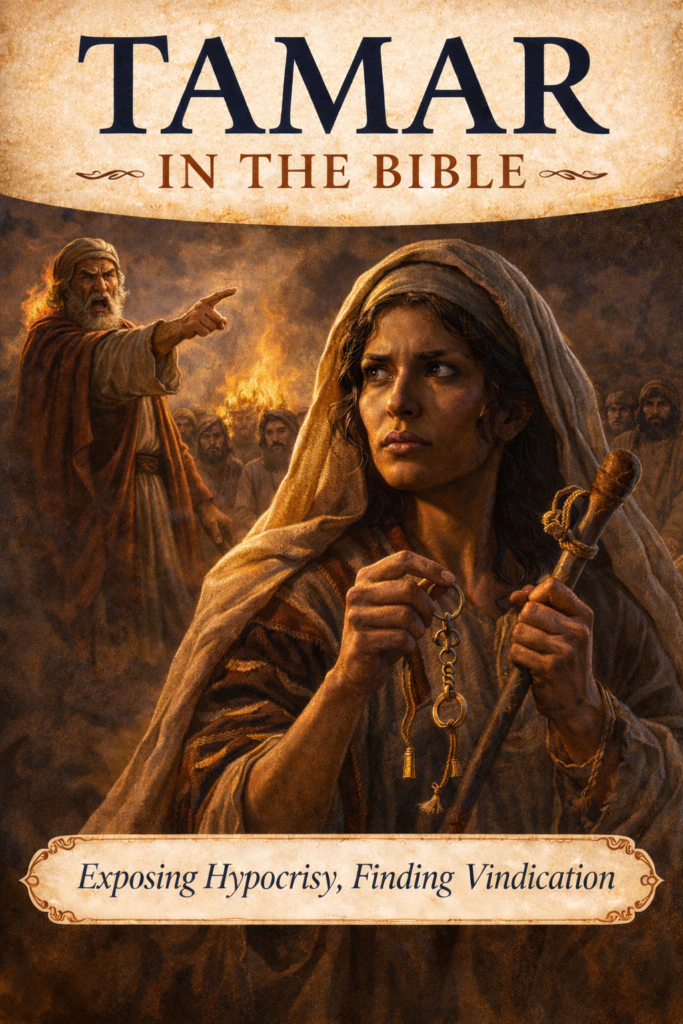
Tamar in the Bible: A Hard Story That Exposes Hypocrisy
The story of Tamar in the Bible is one of the most searching and uncomfortable accounts in Genesis, but it is also one of the most revealing. Tamar’s story is not preserved in Scripture to satisfy curiosity about scandal. It is preserved because it exposes hypocrisy, defends the overlooked, and shows that God judges very differently from proud people. When Judah was ready to condemn Tamar publicly, he had not yet faced his own guilt. That makes Tamar in the Bible a fitting study alongside Christ’s warning in the Sermon on the Mount: “Judge not, that ye be not judged” (Matthew 7:1, KJV). Jesus continues in Matthew 7 by asking how a man can talk about the speck in his brother’s eye while a beam remains in his own. That teaching shines directly on Judah in Genesis 38.
For more on Christ’s kingdom teaching, see The Sermon on the Mount . For the main passages, read Genesis 38 (KJV), Matthew 7:1–5 (KJV), and Matthew 1 (KJV). Readers who want related background can also see Judah in the Bible.
Who Was Tamar in the Bible?
Tamar was the daughter-in-law of Judah. Genesis 38 says Judah took a wife for his firstborn son Er, and her name was Tamar. After Er died, Tamar was left in a vulnerable position inside Judah’s household. She was not introduced as a queen, prophetess, or ruler. She entered the story as a widow whose future depended on whether the men around her would do what was right.
That beginning matters because Tamar in the Bible is a story about power imbalance. Judah held authority. Tamar depended on the family structure to honor what was owed to her. Instead, the chapter shows delay, fear, neglect, and hypocrisy. Tamar becomes one of the clearest examples in Genesis of someone with very little visible power who still becomes essential to the covenant story.
What Happened to Tamar?
After Er died, Judah told Onan to raise up seed for his brother through Tamar. Onan refused the duty in substance, and he also died. Judah then told Tamar to remain a widow in her father’s house until Shelah was grown. But Genesis 38 makes clear that Judah did not actually intend to give Shelah to her. Tamar was left waiting with no real justice and no real future being offered to her.
This is one reason Tamar in the Bible should not be reduced to a shallow morality tale. Before the disguise and confrontation, there is abandonment. Tamar had already been wronged before she ever acted. Judah’s household failed her, and Judah himself withheld what he should have provided. The chapter builds moral tension long before the public exposure ever arrives.
Why Did Tamar Disguise Herself?
When Tamar saw that Shelah was grown and she still had not been given to him, she understood that Judah had no intention of fulfilling his word. She then covered herself and positioned herself where Judah would encounter her. Judah did not recognize her, slept with her, and left identifiable items as a pledge: his signet, bracelets, and staff. Later, when Tamar was found to be pregnant, Judah initially ordered severe public punishment.
Then Tamar sent the pledge items back and said, in effect, that the father belonged to the man who owned them. Judah recognized the items and gave the chapter’s most striking confession: “She hath been more righteous than I; because that I gave her not to Shelah my son.” That moment is the turning point. Tamar in the Bible is not presented as sinless, but she is presented by the text itself as more righteous than Judah in that moment. The story exposes a man ready to condemn publicly while hiding his own guilt privately.
What Does Tamar Teach About Judgment and Hypocrisy?
One of the hardest but most important lessons from Tamar in the Bible is that self-righteous judgment often hides its own corruption. Judah was the patriarchal authority in the story, yet he was the one exposed as failing in justice. Tamar was the vulnerable widow, yet she is the one Judah says was more righteous. In that sense, Genesis 38 stands close to Christ’s words in Matthew 7.
Jesus said, “And why beholdest thou the mote that is in thy brother’s eye, but considerest not the beam that is in thine own eye?” He then says, “Thou hypocrite, first cast out the beam out of thine own eye” (Matthew 7:3–5, KJV). Tamar in the Bible naturally illustrates that warning. Judah was ready to make Tamar a public example before facing his own wrongdoing. He saw what he wanted to punish in her before he was willing to confront what was far worse in himself.
That is why Tamar’s story is not merely about a difficult Old Testament custom. It is also about how God exposes false judgment. Genesis 38 forces readers to slow down and ask deeper questions about justice, responsibility, and hypocrisy. It reminds readers that God sees the plight of the overlooked long before powerful people are willing to admit what they have done.
Tamar and the Messianic Line
Tamar’s story does not end with exposure. It ends with birth. Genesis 38 records that she gave birth to twins, Perez and Zerah. Perez becomes especially important because Matthew 1 includes Tamar by name in the genealogy of Jesus: “And Judas begat Phares and Zara of Thamar.” That means Tamar is not a forgotten side figure in Scripture. She is directly named in the line leading to Christ.
That detail gives Tamar in the Bible extraordinary weight. God did not erase the hard chapter. He wrote redemption through it. The same Bible that shows the sin and failure of Genesis 38 also shows that Tamar’s line was not cast aside. Her story becomes part of the larger testimony that God can work through broken, painful, morally tangled situations without approving the sin involved.
What Can We Learn from Tamar in the Bible?
One lesson is that God sees the vulnerable. Tamar was easy for powerful people to overlook, delay, or mistreat, but Scripture did not overlook her. Another lesson is that hypocrisy will eventually be exposed. Judah judged Tamar quickly until the evidence pointed back to him. That remains a timeless warning against self-righteousness.
A third lesson is that courage can appear in painful and imperfect circumstances. Tamar took a tremendous risk in a situation where she had been denied justice. Genesis 38 is not calling readers to imitate every detail of her method, but it does force readers to recognize the seriousness of the wrong done to her and the truth of Judah’s confession. A fourth lesson is that God’s redemptive plan can move through damaged families and deeply uncomfortable chapters. Tamar’s inclusion in the line of Christ proves that the Lord is not defeated by human failure.
Final Thoughts on Tamar in the Bible
Tamar in the Bible is one of the most difficult Genesis stories, but it is also one of the most revealing. She was wronged, delayed, judged, and then vindicated. Judah failed her and then had to admit it. The chapter exposes hypocrisy, defends the overlooked, and places Tamar inside the family line that leads to Christ.
That is why Tamar deserves a stand-alone article. She is not merely a side note in Judah’s life or a brief example inside a topical discussion. Tamar in the Bible shows that God does not think about justice the way proud people often do. He sees deeper, judges rightly, and is able to bring redemption even through chapters many readers would rather skip. Seen that way, Tamar’s story becomes both a warning and a source of hope: a warning against hypocrisy and neglect, and a source of hope that the Lord remembers those who seem forgotten.